


The Origins of the Keyboard Layout
How the familiar pattern of seven natural keys and five raised keys took shape on medieval organs, and one of the few medieval keyboards that survives today. Text produced by Claude Opus 5.5, lightly edited and augmented.
Seven, to Seven + One, to Seven + Five
The 12-note keyboard, with seven natural keys plus five raised keys per octave, was not invented in a single moment. It developed gradually on church organs and took recognizable form around the mid-1300s. By the time the clavichord and harpsichord appeared in the 14th and 15th centuries, they inherited a layout organ builders had already worked out. The modern design of our piano keyboard (dating to the pianoforte of Bartolomeo Cristofori of Padua, Italy, 1726 or so) follws this scheme.
When All 12 Notes Appeared
The chromatic notes were added to the keyboard one at a time, largely because organs had to keep up with how singers were already performing.
| Period | Development |
|---|---|
| Before c. 1100 | Medieval organs were played with sliders or wide levers rather than narrow keys, and were mostly diatonic. |
| 11th–12th centuries | B♭ became the first "extra" note. Medieval music theory already treated it as a regular note alongside B♮. |
| 13th–early 14th centuries | Other chromatic notes (F♯, C♯, E♭, G♯) were added one by one. |
| c. 1360 | Complete chromatic octaves were in use. The Robertsbridge Codex, keyboard music from about this time, uses essentially all 12 pitch classes. |
Why the extra notes were needed: Singers routinely raised or lowered certain notes to avoid harsh intervals or to strengthen cadences, a practice known as musica ficta. Organs that accompanied or alternated with choirs needed those pitches as well.
An exception that lasted for centuries: The bass was often left incomplete. The short octave omitted rarely used low sharps to save pipes and money, and it survived into the 1700s.
When the Two-Tier Layout Became Standard
Having 12 notes is one thing. Arranging them as two tiers, with raised keys set back between the naturals in groups of two and three, is another.
- Wide early keys. Early organ keys were wide and stiff, sometimes pressed with a fist. Michael Praetorius, writing in 1619, described the keys of the Halberstadt Cathedral organ (1361) as several inches wide. Even so, that organ already placed its chromatic notes on a separate upper row, an early form of the two-tier design.
- Narrowing for fingers. During the late 14th and 15th centuries, keys narrowed enough to be played with individual fingers. The raised keys were shortened and set back, sitting between the naturals in the grouping we know today.
- Fixed by about 1440. Henri Arnaut de Zwolle's treatise from around 1440 shows keyboards whose layout, apart from range and key sizes, matches the modern one.
- Later experiments. The basic design stayed fixed from then on, though builders sometimes tried variations, such as split sharps in the 16th and 17th centuries that gave separate keys for D♯ and E♭.
Do Any Wide-Lever Keyboards Survive?
As far as is known, no medieval cathedral still uses its original wide-key keyboard. Organs were rebuilt, enlarged, or replaced every century or two as musical styles and technology changed, and the earliest wide-key instruments were among the first to go. Most of what we know about them comes from written descriptions and drawings, especially Praetorius's account of Halberstadt.
What does survive:
- The Valère organ in Sion, Switzerland (c. 1430s) is often called the oldest playable organ in the world. It already has narrower finger keys, and its keyboard was modified in later centuries.
- Two organs from Gotland, Sweden, are now in the Swedish History Museum in Stockholm. Only the case survives of the Sundre organ (c. 1370). The Norrlanda organ is far more complete and is described below.
- Reconstructions of early instruments have been built for research and demonstration.
Watch Rob Scallon and Mr. Brink Play a Carillon
A living relative: The fist-played interface survives in the carillon, a set of tower bells played from a keyboard of wooden batons. Carillonneurs strike the batons with loosely closed fists, and the batons are arranged in two tiers like a piano keyboard.
The Norrlanda Organ
The section below is translated from the Swedish Wikipedia article "Norrlandaorgeln" (revision 58947054), licensed under CC BY-SA.
Overview
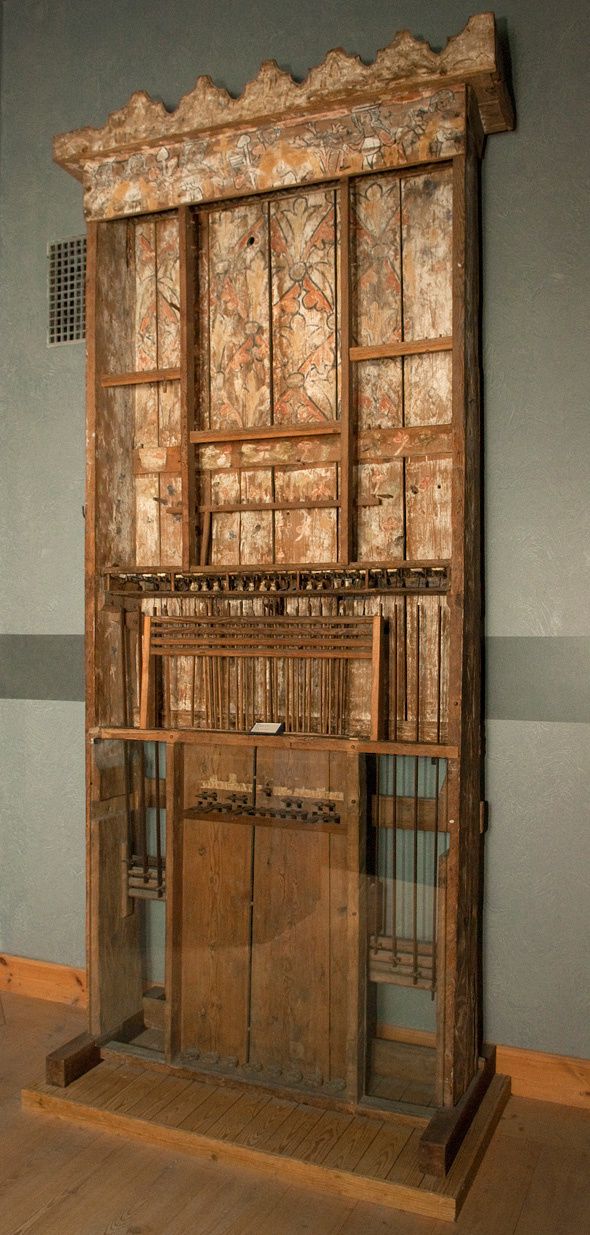
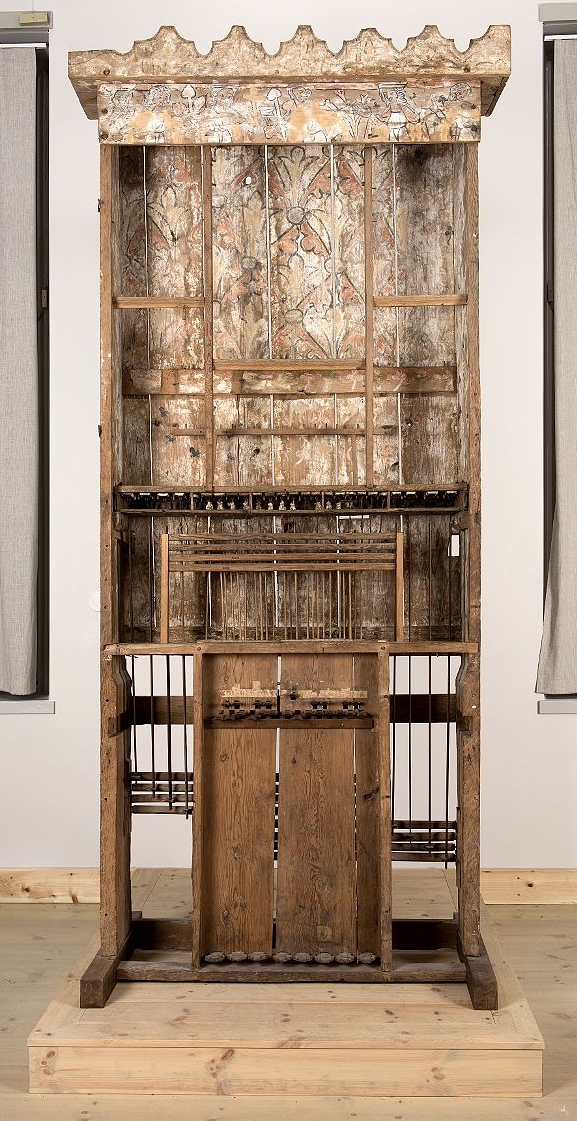
The remains of the Norrlanda organ are now kept at the Swedish History Museum (Statens historiska museum) in Stockholm. The organ formerly stood in Norrlanda Church on Gotland. It was built sometime between 1370 and 1430, which makes its preserved parts among the oldest in the world.
 |
 |
What Survives
The organ is nearly complete; only the bellows and pipes are missing. The following have been preserved:
- the organ case
- the key action, including its roller board
- the wind chests
- the pedal keyboard
How It Worked
- Compass: 26 notes.
- Key action: Each key was connected to a pallet (a valve) that let air into between three and five pipes at once.
- Pipe layout: The manual pipes were arranged diatonically, with the pedal pipes standing on either side of them.
- Sound: It was a mixture organ (Blockwerk). Every key sounded all of its pipes together, and the organist had no way to choose different registrations.
Technical Terms
- Roller board (Swedish vällbräda): A mechanism that carries each key's motion sideways to the correct pallet when the pipes do not sit directly above the keys.
- Mixture organ / Blockwerk: An organ without separate stops, so all the pipes belonging to a key sound whenever it is pressed. Later organs added stops so players could select among different sounds.
- "Arranged diatonically": This describes how the pipes stood on the wind chest, not necessarily the layout of the keyboard. Organ builders often place pipes in a different order from the keys for balance and to save space.
Why It Matters
The Norrlanda organ is one of the very few places where a medieval organ keyboard and its mechanism actually survive. It is no longer in its church and can no longer be played, but drawings and a replica have been made from it, giving a rare direct look at how organs were built around 1400.